
About 15 years ago I started looking at the way we did learning in the workplace and suspected we needed to modernise and reform. I was working in local government where we had little money as a result of decisions made about austerity and the funding in the public sector.
I’m seeing similar conversations happening now – it’s all cyclical. Prompted by Donald H Taylor’s post on Wednesday, I’ve had a ponder about where we are; as we navigate these challenging times, it’s worth noting how the current situation echoes past experiences.
Budgets are being squeezed and the L&D function is being challenged to do more with less AND be more effective as well. This gap in productivity isn’t just a UK malaise; it’s a global challenge following global events; the pandemic, the reset in working locations and practice, and the explosion of AI through LLM and other tools.
Any of these three external factors on their own would be enough to shift L&D practice on its axis; or you would expect them to. There are, as we had 15 years ago, strong forces at play. While budget constraints are familiar territory, the rapid advancement of AI introduces a new dimension to our L&D landscape
We’re in the space we were on 2010-12 where funds are shrinking but the additional factor that “AI will solve everything” is a powerful mantra echoing through organisations. But it won’t happen in the way we expect.
In the liminal space between permission and forgiveness, employees are taking risks. For example, we know there’s a new trend starting: nearly eight in 10 (78%) of AI users are bringing their own AI to the workplace and Bring Your Own AI (BYOAI) is happening across organisations because employers aren’t allowing the use of tools on work systems.
Within organisations, this is creating tensions as expectations are shifting. The CEO can use these tools – why can’t the organisation? We have organisations like the Department of Work and Pensions (DWP) banning the use of ChatGPT for employees, while at the same time recognising AI’s benefits.
“AI will allow us to create a more human service that cares better for the vulnerable, provides colleagues with more rewarding jobs and takes the pressure off public finances so money can be spent where it matters most.”
Simon King – Director of AI and Innovation at DWP Digital
The problem for organisations is developing an AI platform/tool/system/strategy which isn’t necessarily there yet. I’m seeing some interesting uses of AI in learning in content design and channel delivery. However, there hasn’t been a shift in what people do differently yet and predict some expensive mistakes being made which will burn people on the use of AI. It will happen when a platform has been adopted and a new tool and technology becomes available. The investment in AI is still high and when we see new systems, such as Google’s Notebook LM, previous purchases will become obsolete.
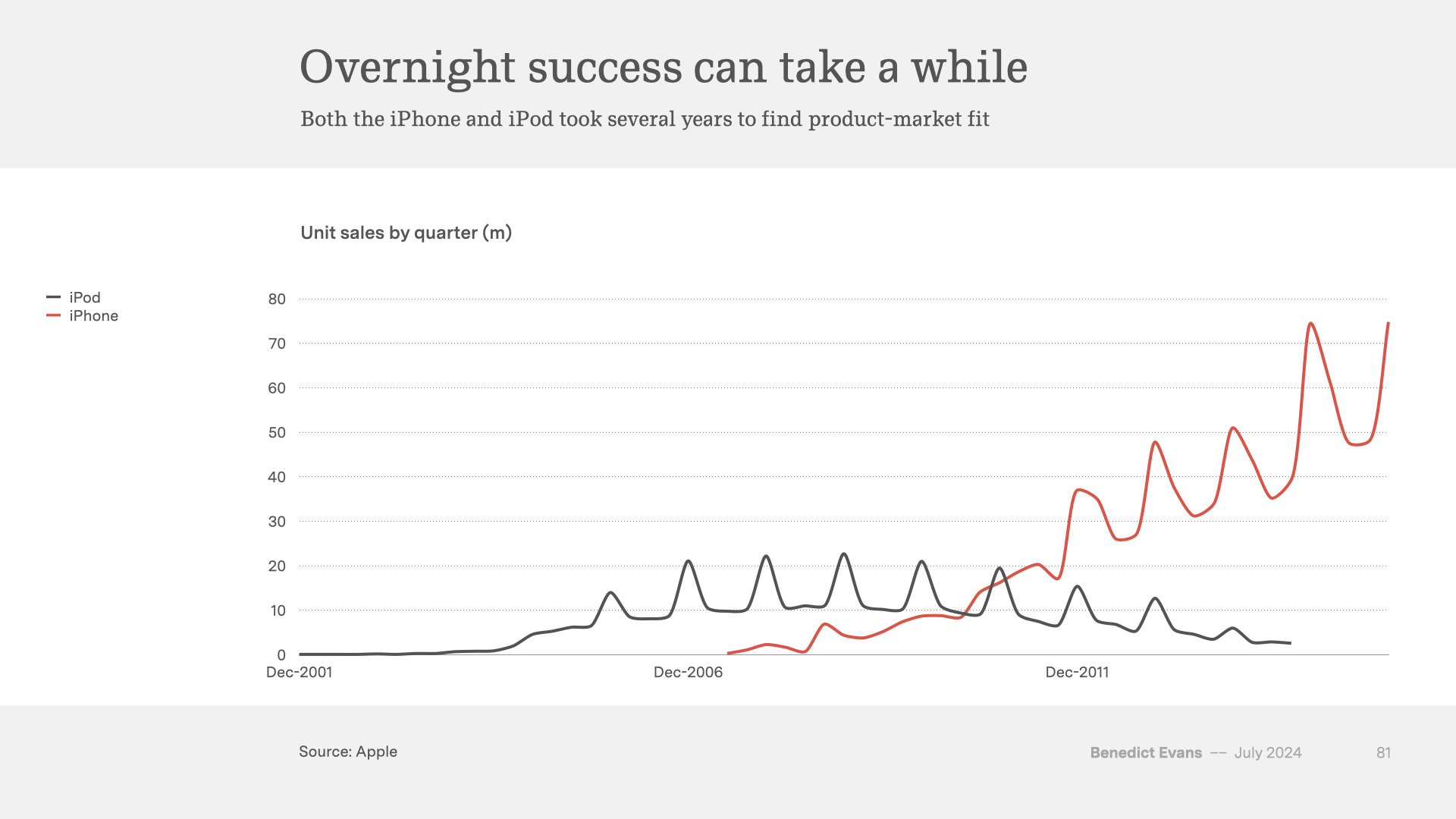
We also have a vendor market whose desire to maintain their status quo is incredibly powerful. 15 years ago people were pushing traditional courses and classes in spite of the online and modern. There is still a market for this – in some cases it’s growing as people gain digital fatigue – but it is perceived as costly, less effective and dated by some. The same could be said for the current LMS/LXP/LRS vendor space where the model of the last decade is being pushed back. The pace of change won’t be as quick as some have forecast, as Benedict Evans says – overnight success takes a while and both the iPhone and iPod took years to find product-market fit.
There is also a very clear business reason for vendors to push back – why kill the golden goose which has been the business model for so long? But these problems aren’t simply vendor related. Amidst technological shifts, we’re also grappling with a fundamental change in how and where work happens.
We are still working out what hybrid working means. We know we can work flexibly by time and location. There is still – and will remain – a concerted effort to get people back into an office. Again, lots of forces at play which include business rents, pension funds, and supporting commerce being affected by fewer people in offices. There are pressures here to bring back in-person activity as a way of reminding people of the benefits of being together. We still haven’t worked out hybrid job design. This is not designing jobs in the traditional ways of tasks to be done, but looking at the range of outcomes required and designing approaches which will reflect a mixed input and output on a day by day and week by week basis. As I said yesterday, if organisations are only looking at skills as a function of the L&D teams, we’re still a long way from hybrid organisations.
This matters of course, since L&D should be integrated into the workplace practice, not just the ‘thing’ which we do to keep people trained. If, as we’ve highlighted, work is inconsistent in its future design, how are we meant to design L&D?
We’re in a strange place and things are still changing.
As I repeat regularly, people don’t fear change but, they fear what they lose as a result of change.
In the current environment for vendors it’s revenue, reputation, market, etc. Change things in the WAY it’s produced to reduce costs but maintain an offer which is still content based. The difference now is the teams of Instructional Designers (IDs) who have happily produced, repackaged, repurposed, and refolded content for years are being asked to do less. They’re a cost and one which AI can be used to save.
For L&D functions, the fear is also reputational which explains some of the push back from AI adoption – why would I use a tool which might not provide as good a response as what we’ve always done? I’m seeing a lot of criticism of AI tools by people who haven’t understood how they work and their preliminary view is they are just “faster horses”. There are other fears though. The fear of being lost as the ‘Oracle’ at the centre of the organisation, knowing about ‘knowledge’. There’s also a fear of losing customers as we shift from being the friendly corner shop, packaging up courses as people request them.
L&D is shifting, but, since it is no more than groups of people, by definition so are we. The tools may change, but our role in supporting people remains constant. It’s not about resisting change but embracing it thoughtfully and understanding.
So, who’s ready to navigate what’s next? Please let me know in the comments your thoughts on this.
If you ever want to discuss this, think I can help you make sense of it, or want to know how you can develop your practice, please do get in touch.
 Lost and Desperate