
The starting point of all achievement is desire. Keep this constantly in mind. Weak desire brings weak results, just as a small fire makes a small amount of heat.
Last time I wrote about a model that we’d been working on as we searched for a different way to do what we do. As Napoleon Hill phrased quite succinctly above, we were keen to make sure this model could work, and put a lot of energy into testing, discussing and identifying its nuances.
We had spent a lot of time getting to the stage we were at last time but continued to tidy the model we’d worked on. There was a number of reasons for this:
- Ease of description – we needed to be able to explain what each part means in clear terms,
- Professionalism – it needed to look polished
- Clarity – it should express in more simple terms how it should be used
With a bit of time we turned it from this:
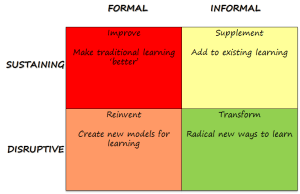
into this:

Once we started talking about this structure with other L&D teams we realised that it was essential to be able to explain where the L&D team need to start to use this model. Too often, people guessed at a box to start from – Improve and Supplement are the most mentioned.
Unfortunately, looking at the model and choosing a delivery box demonstrates the provision mindset. This provision mindset is about L&D being the suppliers of ‘learning stuff’. It’s a throwback to the training mentality that pervades L&D where content is valued above context and L&D professionals try and create original Mexican food. This isn’t what learners need now and there’s a good piece about this by Steve Wheeler where he explains this much more elegantly than I.
The starting point isn’t which box you need to create a provision within. The starting point is about identifying what the intrinsic sustaining elements are within the learning design and identifying all other activities that may be classed as disruptive. It’s as simple as asking, what does the learner have to know and what happens if they don’t learn it?
Let’s think about the time management example that I’ve written about previously.
Look at the list I provided before:
- Time bandits
- Personal Planning
- Personal Goals (SMART or WISE, your choice)
- Procrastination
- Managing time in meetings
- Managing Email
- Urgent/Important matrices
- Delegation (the art of)
None of these activities could be described as sustaining since none have a recognised standard to which they need to be learnt. None of these elements have to be provided to a standard within the learning intervention itself.
There may be expected standards of performance from within the organisation in terms of policies, codes of conduct, management practices, etc. to support some of the areas listed above. However, these standards exist outside of a course and the course does not need to be created using them as they can be learnt from existing resources.
What do you think? Is it easy to highlight the activities that are sustaining in your offer? Do you offer lots of mandatory activities to make sure you keep control of the standards the organisation should be managing?
Let me know your thoughts below.
 Lost and Desperate
[…] posted last time about the need to identify the parts of your L&D offer that were sustaining. This is […]
LikeLike
[…] bring you up to speed, we’re attempting a new way of creating L&D support at my workplace, using a format that we’ve developed over some […]
LikeLike
[…] correct in her assumption that LD wants to maintain control – only this week someone asked me about our model and how we could control the outputs that came from it. It seems the need/desire to control and to […]
LikeLike
[…] to work (doesn’t it always). They asked about what I was doing and I explained about the disruptive learning support we’re working […]
LikeLike
[…] needs to learn 1, 2, and 3 to this standard”. I’ve talked about these parts before within the sustaining part of the work we […]
LikeLike
[…] the start. This is the essence of self-determination as opposed to self-direction. Nine years ago, I wrote a series of blog posts that explained this approach and the content crafted here rather serendipitously falls into the […]
LikeLike